
A
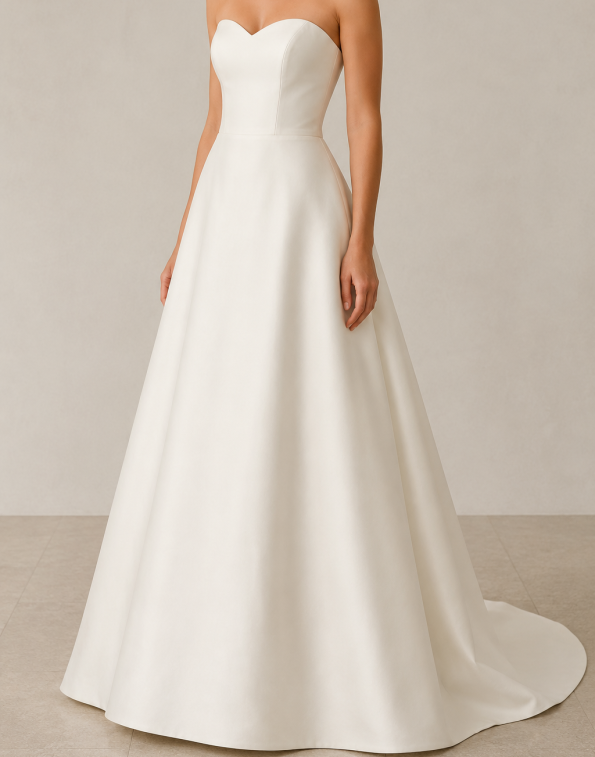
- A-line – A silhouette that fits at the bodice and flares gradually outward from the waist to the hem, forming the shape of the letter A. One of the most universally flattering wedding dress shapes because it skims the hips without being tight and moves naturally. Suits nearly every body type.
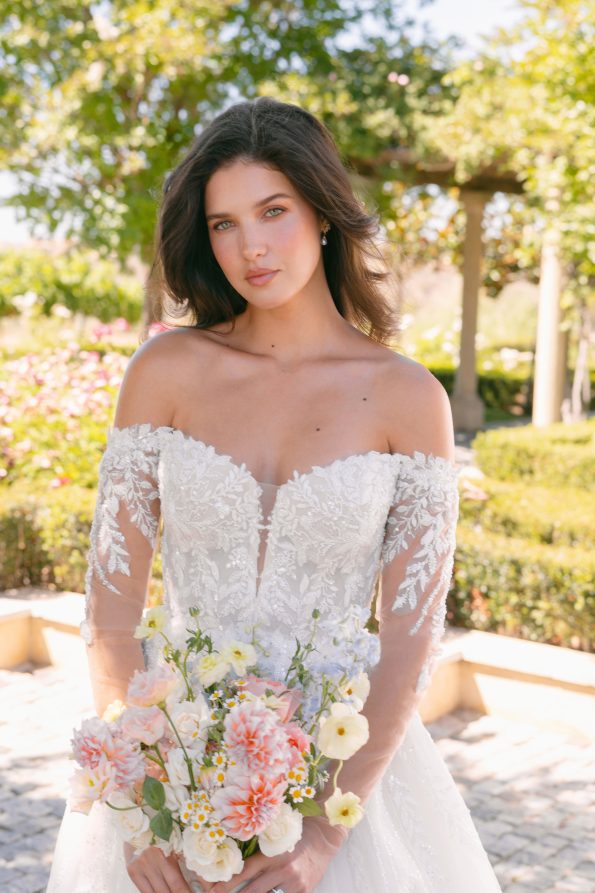
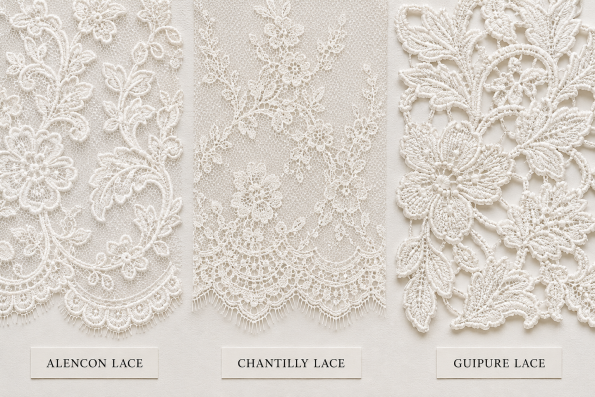
- Alencon Lace – A fine needle-point lace originating from Alencon, France, distinguished by its delicate floral motifs outlined with a corded thread on a sheer net ground. Considered one of the most luxurious laces used in bridal fashion. Often found on haute couture and designer gowns. The cord outlining makes the pattern pop and adds subtle dimension.
- Applique – A decorative technique in which fabric pieces, lace motifs, beading clusters, or embroidered designs are cut out and sewn onto the surface of a gown rather than woven into the base fabric. Appliques allow for intricate placement of detail exactly where the designer wants it, such as scattered florals along a skirt or clustered embellishment at the waist.
- Asymmetrical Hem – A hemline that is intentionally uneven, typically higher on one side and longer on the other. Also called a hi-lo hem. This style adds a modern, fashion-forward edge and is often used in less formal or beach wedding gowns.
- Asymmetrical Neckline – A neckline that does not mirror itself on both sides. One shoulder may be covered while the other is bare, or a strap may appear only on one side. Creates visual interest and a contemporary feel.
B
- Back Interest – A design term referring to decorative detail specifically placed on the back of a gown, including elaborate button closures, illusion panels, lace inserts, dramatic bows, or low-cut backs. Often described in bridal marketing as a focal point, since the back of the gown is what guests see during the ceremony processional.
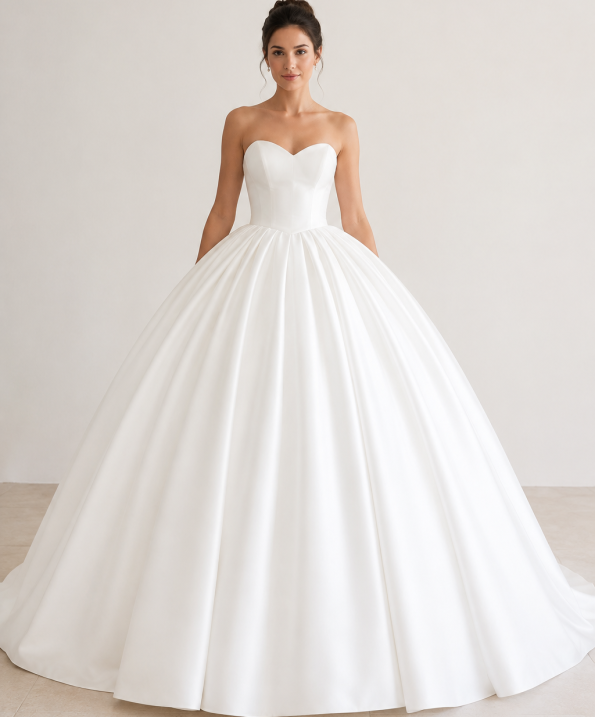
- Ballgown – The most voluminous and dramatic of all wedding dress silhouettes. Features a fitted bodice and a full, dramatic skirt with substantial volume typically created by layers of crinoline, netting, or tulle. The silhouette creates a classic, princess-like appearance. Best suited to formal and black-tie ceremonies.
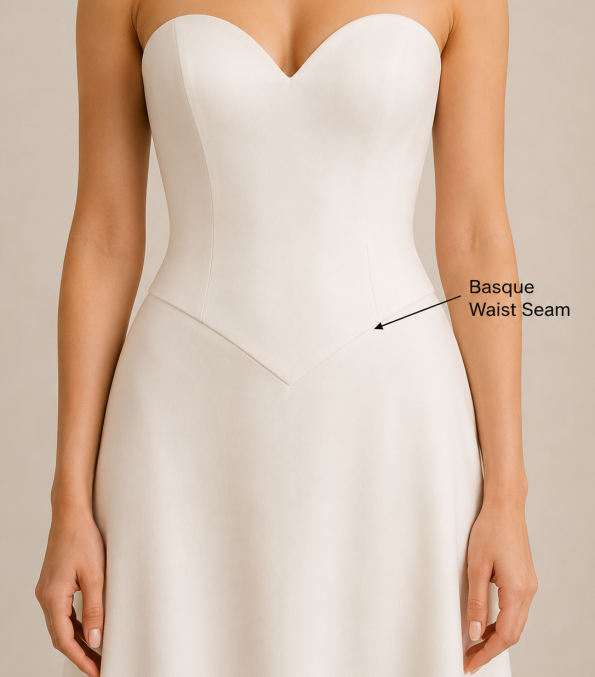
- Basque Waist – A waistline that dips into a V-shape or pointed shape at the center front, elongating the torso and creating an elegant, elongated line. Often seen in traditional and romantic gown styles. Named after the Basque region of France and Spain.
- Bateau Neckline – Also called a boat neck. A wide, horizontal neckline that runs across the collarbone from shoulder to shoulder with minimal depth at the front or back. Creates an elegant, elongated shoulder line and works particularly well on brides with narrow shoulders. Popularized by Audrey Hepburn in the 1950s.
- Beading – The application of small beads, typically glass, crystal, or seed beads, onto the surface of a fabric by hand or machine. Beading on wedding gowns ranges from subtle accents along a neckline to heavily encrusted, all-over patterns on the entire bodice. Hand beading is significantly more labor-intensive and costly than machine beading.
- Bishop Sleeve – A sleeve style that is full and voluminous throughout the arm but gathered into a fitted cuff at the wrist. Named for the sleeves of bishops’ vestments. Adds a romantic, vintage, or editorial quality to a wedding gown.
- Blusher – The front-facing section of a two-tiered veil that is worn over the bride’s face during the ceremony processional and lifted by the groom or the bride at the altar. Not all veils include a blusher.
- Bodice – The upper portion of a wedding dress, from the waist or hip upward. The bodice includes the neckline, cup or bust area, and back closure. Its structure, boning, and lining have a major impact on fit and support.
- Boning – Rigid or semi-rigid strips sewn into the interior of a bodice to provide structure, support, and shape. Historically made from whalebone, modern bridal boning is typically made from plastic or steel. Steel boning provides firmer support and is common in corset-style bodices. Plastic boning is more flexible and suitable for lighter gowns.
- Bridal Muslin – A prototype or sample of a custom gown made in inexpensive muslin fabric before cutting into the final, expensive materials. Also called a toile. Allows the designer or seamstress to test the fit and construction before committing to the real fabric. Commonly used in bespoke or semi-custom bridal work.
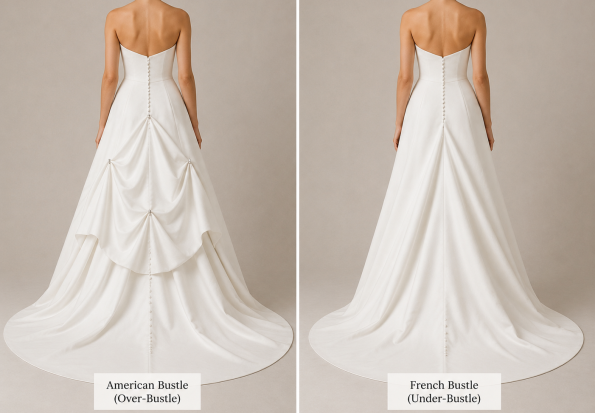
- Bustle – A method of securing a long train up and out of the way during the reception, typically by looping or buttoning sections of the train to the interior or exterior of the skirt. There are several types, including the American bustle (loops on the outside), the French bustle (buttons or ties inside), the ballroom bustle (multiple points creating a full silhouette), and the over-bustle (fabric cascades up and over). Your seamstress will typically sew and demonstrate your bustle during alterations.
- Butterfly Sleeve – A short, fluttery sleeve that fans out from the shoulder in a wide, wing-like shape. Soft and romantic, this sleeve style works well with bohemian and garden wedding aesthetics.
C
- Cap Sleeve – A very short sleeve that barely extends over the shoulder, covering the top of the arm only. Provides minimal coverage while still offering a finished look at the shoulder. Common in vintage-inspired and modest bridal styles.
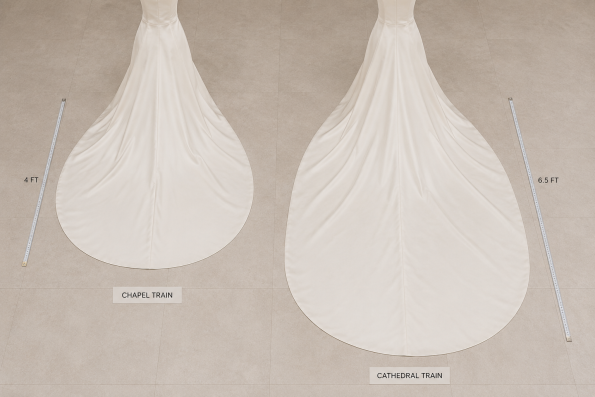
- Cathedral Train – One of the longest train lengths, extending 6 to 8 feet or more from the waist or back of the gown along the floor. Creates a grand, formal effect suited to large church or cathedral ceremonies. Requires significant space and careful handling.
- Cathedral Veil – A veil that extends to or beyond the length of the train, typically at least 108 inches long. Designed to complement the formal grandeur of a cathedral-length or royal train gown.
- Chapel Train – A moderately long train that extends 4 to 5 feet from the waist. Less dramatic than a cathedral train but still creates a formal silhouette. Well-suited to traditional ceremonies in both small and large venues.
- Charmeuse – A lightweight, semi-glossy fabric with a smooth, soft drape on the front surface and a matte finish on the reverse. Often used for slip-style and bias-cut wedding gowns. More delicate than satin and requires careful handling. Creates a fluid, body-skimming look.
- Chiffon – A sheer, lightweight, plain-woven fabric made from silk, nylon, or polyester. Flows and drapes elegantly and is frequently used in bohemian, beach, and destination wedding gowns, as well as bridesmaids dresses. Layers of chiffon create soft, ethereal movement. More forgiving on the body than structured fabrics.
Check out this Chiffon wedding dress for reference. - Choker Neckline – A neckline with a high band that sits snugly around the base of the neck, similar to a choker necklace. Often made of sheer illusion fabric with lace or beading detail, creating an elegant, editorial look.
- Cinched Waist – A waist that is drawn in and fitted, emphasizing the difference between the waist and the hip or skirt. Achieved through boning, structured seaming, corset lacing, or a sash.
- Cold Shoulder – A sleeve style that covers the upper arm but has a cutout or open panel at the top of the shoulder. Creates a modern, fashion-forward silhouette.
- Column Silhouette – A sleek and modern silhouette that falls straight from the neckline to the floor, creating a clean and elegant shape without extra volume, dramatic flare, or a full skirt.
- Corset – A structured undergarment or bodice style featuring boning and lacing, designed to shape and cinch the torso. Bridal gowns with corset-style backs use laces at the center back to allow for adjustable fit. A true corset-style gown uses steel or spiral steel boning in the bodice for maximum structure and shaping.
- Corseting – The process of tightening lacing at the back of a corset-style gown to achieve the desired fit. Distinct from standard zipper or button closures. Corseted backs allow more flexibility in fit during alterations.
- Court Train – A shorter train that extends 1 to 2 feet from the waist along the floor. Adds elegance without the logistical challenge of managing a longer train. Suitable for a range of ceremony types and venues.
- Cowl Neck – A draped, soft fold of fabric at the neckline that falls in loose, elegant folds. Can be at the front or back of the bodice. Particularly suited to lightweight fabrics like silk and chiffon. Lends a fluid, Grecian aesthetic.
- Crepe – A fabric with a distinctively textured or crinkled surface, available in lightweight and heavier weights. Matte crepe is a popular choice for sleek, minimalist bridal gowns because it drapes well and photographs beautifully without reflective shine. Holds its shape better than chiffon and flows more softly than satin.
- Crinoline – A stiff fabric, or a structured petticoat made from crinoline, used to support and add volume to skirts. Crinolines are layered underneath ballgown and A-line skirts to maintain their fullness. Historically made from horsehair and linen; modern versions are typically made from stiff netting or organza.
D
- Dart – A folded and sewn triangular tuck in fabric used to shape a flat piece of material to conform to the curves of the body. Darts are sewn at the bust, waist, and hips to create a tailored fit in the bodice.
- Deep V-Neck – A neckline that plunges downward in a deep V shape, creating a dramatic, sensual look. The depth of the V can range from modest to very low. Often accented with sheer illusion fabric or light embellishment to provide structure and modesty.
- Destination Wedding Dress – A term broadly used to describe gowns suited to outdoor, beach, or travel-intensive weddings. Typically made from lightweight, packable fabrics like chiffon, georgette, or lace. Easier to transport and less affected by heat and humidity than structured gowns with heavy boning and layers.
- Detachable Train – A train that can be removed by unhooking or unbuttoning it from the main skirt, typically used when transitioning from ceremony to reception. Allows the bride to wear a dramatic train during the ceremony and switch to a shorter, more practical skirt length for dancing.
- Duchess Satin – A heavy, tightly woven satin fabric with a high-gloss surface. More structured and less drapey than charmeuse or lightweight silk satin. Commonly used in formal, traditional wedding gowns and ballgown silhouettes. The weight and stiffness help maintain the shape of full skirts.
E
- Ecclesiastical Train – The longest of all train lengths, reserved for royal and extremely formal ceremonies. Extends 12 feet or more and typically requires dedicated train bearers or page boys during the processional.
- Edging – A decorative trim applied along the hem, neckline, or sleeves of a gown. Common edging options include horsehair braid (which adds stiffness and definition to hems), lace trim, ribbon, and scalloped edges.
- Elopement Dress – A term for shorter, simpler wedding gowns designed for intimate ceremonies, city hall weddings, or courthouse weddings. Typically knee-length to midi-length, often in minimalist styles.
- Embellishment – A general term for any decorative detail added to a gown, including beading, sequins, embroidery, appliques, feathers, crystals, ribbons, or floral accents.
- Embroidery – Decorative stitching applied to fabric by hand or machine. Bridal embroidery can be delicate and tonal (matching the fabric color for subtle texture) or elaborate and colorful. Floral embroidery is a major trend in contemporary bridal fashion.
- Empire Waist – A silhouette in which the waistline sits just below the bust rather than at the natural waist. The skirt falls straight from this raised seam. Creates an elongated, elegant look and minimizes the appearance of the waist and hips. Commonly associated with Regency-era fashion and popular in maternity bridal gowns.
- Eyelet – A small hole in fabric, typically reinforced with thread or metal, used in corset lacing or as a decorative detail. Eyelet fabric features patterns of small holes with embroidered edges, creating a lightweight, textured look.
F
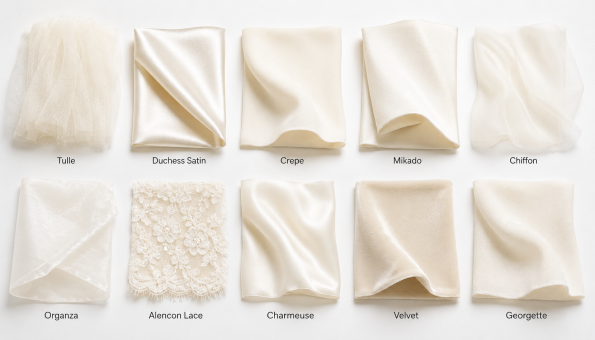
- Fabric : The material a wedding dress is made from shapes everything about how it looks, moves, feels, and photographs on your wedding day. Two gowns with identical silhouettes can feel completely different the moment fabric changes. Understanding the most common bridal fabrics helps you walk into your appointment knowing what to ask for and why it matters.
Types of Fabric:
- Tulle : A lightweight fine netting used in skirts, overlays, and veils. Ranges from soft and flowing to stiff and structured depending on its density.
- Satin : A smooth, glossy fabric with a high sheen. Duchess satin is the heaviest and most structured version while charmeuse satin is lighter and more fluid.
- Crepe : A smooth matte fabric with excellent drape and a subtle texture. Popular in sleek fitted silhouettes because it skims the body without adding bulk.
- Mikado : A structured matte fabric with a subtle sheen. Heavier than satin, it holds its shape beautifully and is a top choice for modern minimalist designs.
- Chiffon : A sheer, lightweight flowing fabric used for overlays, sleeves, and romantic skirts where softness and movement are desired.
- Organza : Sheer like chiffon but stiffer. Holds its shape and is used for structured overlays, dramatic ruffles, and added skirt volume.
- Lace : An intricate fabric formed by looping or twisting threads into open decorative patterns. Common types include Alencon, Chantilly, guipure, and Venice lace, each with a distinct texture and weight.
- Charmeuse : A lightweight silky fabric with a satin front and matte back. Drapes fluidly and is often used in slip-style and minimalist gowns.
- Velvet : A rich pile fabric with deep color and a soft surface. Used almost exclusively in winter bridal collections and photographs beautifully in low light.
- Georgette : A crinkled, slightly heavier version of chiffon. More opaque and suitable for layered skirts and flowing sleeves.
- Fabric Weight – A reference to how heavy or light a fabric feels, which affects how the gown drapes, holds shape, and moves. Heavyweight fabrics like duchess satin create structure and volume. Lightweight fabrics like chiffon and georgette flow and drape close to the body. Matching fabric weight to your wedding venue, climate, and desired silhouette is essential.
- Feather Trim – Feathers applied to the hem, cuffs, or neckline of a gown. Ostrich feathers are the most common in bridal fashion, creating a glamorous, Old Hollywood feel. Popular in fashion-forward and statement bridal looks.
- Fishtail Silhouette – It is commonly called a mermaid or sometimes a trumpet-style gown. It is a fitted bridal gown that hugs the body closely through the bodice, waist, hips, and often the thighs, then flares out dramatically near the knees or lower hem, creating a shape that resembles a fish’s tail.
- Fit-and-Flare – A silhouette similar to mermaid but with the flare beginning slightly higher, typically at or just below the knee rather than mid-thigh. Hugs the body through the hips and thighs but offers slightly more ease of movement than a true mermaid gown.
- Flounce – A ruffle or gathered strip of fabric attached along one edge to a skirt or hem, creating movement and volume. Multiple flounces stacked vertically create a tiered effect.
- Flutter Sleeve – A very short, soft sleeve that drapes loosely from the shoulder with a flowing edge. Similar to a butterfly sleeve but more delicate and without a defined shape. Common in boho and romantic bridal styles.
- French Seam – A seam finishing technique in which the raw edges of the fabric are enclosed inside the seam, creating a clean finish on both sides of the fabric. Adds durability and a polished appearance on sheer or delicate fabrics.
G
- Georgette – A lightweight, slightly crinkled, matte-finish fabric typically made from silk or polyester. Slightly heavier and less transparent than chiffon, with a subtle texture. Drapes beautifully and moves freely, making it popular in boho and flowy wedding gown styles.
- Guipure Lace – A heavier, denser lace in which the design is formed by thick thread worked around a pattern, without a net ground. The motifs are connected by bars or braided threads rather than by a mesh backing. Also called Venetian or chemical lace. Creates bold, graphic lace patterns. Often cut into appliques.
- Gusset – An insert of fabric sewn into a seam to add room, ease of movement, or structural support. Underarm gussets in sleeves allow greater range of motion. Common in gowns with very fitted sleeves.
H
- Halter Neckline – A neckline formed by straps that extend from the front bodice upward and around the back of the neck, leaving the shoulders and upper back bare. Creates a sporty yet elegant look and works well for brides with broad shoulders as it draws attention upward and inward.
- Handkerchief Hem – A hemline with multiple points of varying lengths, resembling the corners of a handkerchief. Creates a whimsical, flowing look and is popular in boho and garden wedding gowns.
- Hi-Lo Hem – It is a modern, versatile bridal gown featuring a hemline that is shorter in the front, often above the knee and longer in the back, typically ending in a chapel train.
- Horsehair Braid – A stiff ribbon woven from nylon (historically horsehair) sewn inside the hem of a skirt. Adds body and definition to the hemline, helping it maintain its shape and keeping it from clinging to the legs. Common in A-line and ballgown hems.
- Hourglass Silhouette A silhouette that fits closely at both the bust and hips while cinching dramatically at the waist, creating a defined waist and balanced upper and lower proportions. Typically achieved with structured boning, strategic seaming, or a sash.
I
- Illusion Back – A back section made from sheer, transparent fabric (typically tulle or mesh) that creates the appearance of an exposed back while still providing light coverage. Often decorated with lace appliques or beading placed strategically on the illusion fabric.
- Illusion Neckline – A neckline in which the actual structural edge of the bodice sits lower than the visible neckline. The area between the structural edge and the visible neckline is made from sheer, transparent fabric adorned with embellishment or lace. Creates the effect of an intricately detailed, high neckline while maintaining the bridal look.
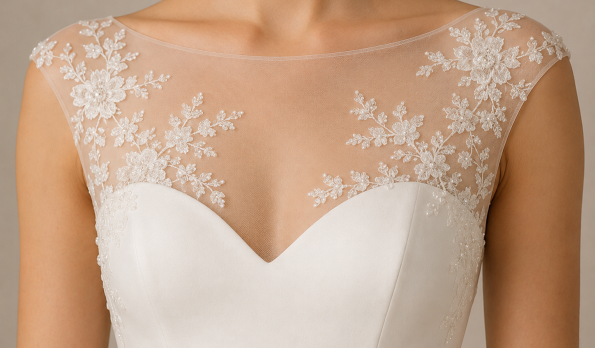
- Illusion Sleeves – Sleeves made from sheer fabric, creating the effect of coverage while remaining visually light and ethereal. Often decorated with lace or embroidery.
J
- Jacquard – A fabric woven on a jacquard loom, in which complex patterns are woven directly into the fabric structure rather than printed or embroidered on. Creates rich, textured patterns that are permanent and durable. Used in structured, formal wedding gowns.
- Jewel Neckline – A simple, round neckline that sits at the base of the throat, following the natural curve of the collarbone. Classic, understated, and versatile. Often used in minimalist or modest gown designs.
K
- Keyhole Back – A back design featuring a small, usually teardrop-shaped or oval cutout at the nape of the neck or center back, typically edged with a button closure or covered button. Adds a delicate detail to an otherwise modest or covered-back gown.
- Keyhole Neckline – A neckline with a small, geometric cutout below the main neckline opening, revealing a peek of skin. Adds an interesting detail to an otherwise simple front.
L
- Lace – An open, decorative fabric formed by looping, twisting, or knitting threads into intricate patterns. Major lace types used in bridal fashion include Alencon, Chantilly, Guipure, Venetian, and point d’esprit. Each has a distinct visual weight, texture, and pattern scale. Lace can be used as the entire fabric of a gown or layered over another base fabric.
- Layering – The use of multiple fabric layers to add opacity, volume, texture, or visual depth to a gown. Tulle, chiffon, and organza are frequently layered over an underskirt or base fabric.
- Leg Slit – An opening in the skirt at the front, side, or back seam that allows freedom of movement and reveals the leg. The depth and placement of the slit affect both function and style.
- Lining – The inner layer of a gown that provides comfort against the skin, conceals interior construction, and adds structure. Bridal gowns are typically lined in silk, polyester, or cotton. A well-fitted lining is as important as the outer fabric for a polished, comfortable fit.
- Luster – The degree of sheen or brightness a fabric reflects. High-luster fabrics like duchess satin catch the light dramatically. Low-luster or matte fabrics like crepe and chiffon appear softer and more understated. Luster level affects how a gown photographs.
M
- Mantilla Veil – A traditional Spanish-style veil made from lace or chiffon, worn draped over the head without a comb, often held in place by a lace comb or hairpins. The lace trim is typic