What this guide covers
- Who Alena Leena is
- What makes an Alena Leena gown recognisable
- The sixteen Alena Leena gowns at Flares Bridal
- Silhouettes, ball gown through soft A-line
- Fabrics and detail work
- What an Alena Leena gown costs
- Alterations on a beaded or lace gown
- How Alena Leena compares with the other designers on our floor
- Trying Alena Leena in Walnut Creek
- Frequently asked questions
Who Alena Leena is
Alena Leena is a bridal house founded by its head designer, Alyona Kostyk. The creative studio sits in Cape Town, South Africa, and the gowns are produced by the brand’s team in Ukraine, from Italian satin and silk.
Two things follow from that, and they matter more than any adjective.
The first is that every gown is made to your measurements. These are not sample sizes bought in and taken in afterwards. You order your gown, it is made for your body, and the decisions about fabric finish and closure are yours at the point of order rather than something you negotiate at a fitting.
The second is the naming. Every Alena Leena gown is named after a flower or a plant, and the brand treats that as its design method rather than its branding. Each dress starts from the symbolism attached to its flower. Once you know, you start seeing it: Dahlia’s deep folded pleats read as petals, Peony’s three-dimensional florals are the flower itself.
That is the honest shape of the brand. What we cannot tell you is when it was founded, because the designer does not publish a date and we will not guess at one.
What makes an Alena Leena gown recognisable
If you put sixteen of these gowns on one rack next to sixteen from any other designer, three things separate them.
Structure under softness. Almost every Alena Leena bodice is properly built: vertical corsetry, boning, supportive cups, and sometimes a built-in bodysuit. Then the outside is lace, pleated tulle or three-dimensional florals. You get the hold of a corset and the look of something delicate, which is a harder combination to achieve than either on its own.
Hand-applied detail. The beading and the floral appliqué are placed, not printed and not machine-scattered. On Clivia and Cattleya the beaded florals follow the body rather than sitting in a repeating pattern. You can see it at arm’s length and you can feel it in the weight.
Volume you can dial up or down. Several gowns are designed to work with or without a structured petticoat. The same dress can be a full ball gown or a soft, relaxed A-line depending on what you put underneath, which is unusual and genuinely useful if you have not decided how dramatic you want to be.
The collection is built on ball gowns and A-lines, with a single exception. Serraria is form-fitting, and it is the only one of the sixteen that is. If a close-fitting silhouette is what you are after, try Serraria, and try it alongside another designer on our floor rather than expecting more like it from this one.
Did you know? The flower naming is not loose. Dahlia belongs to the designer’s Petal Crush collection, and the names run through genuine botany rather than pretty words: Clivia and Cattleya are orchid and lily genera, Armeria is sea thrift, Kerria is a flowering shrub, Gardenia and Nerine are flowering plants, Agave and Nolina are succulents. The brand is naming plants, not inventing names that sound floral.
The sixteen Alena Leena gowns at Flares Bridal
This is what is on the floor in Walnut Creek, not the designer’s global catalogue. Collections vary by stockist, so a gown you have seen on another shop’s site may not be one you can try here.
| Gown | What it is |
|---|---|
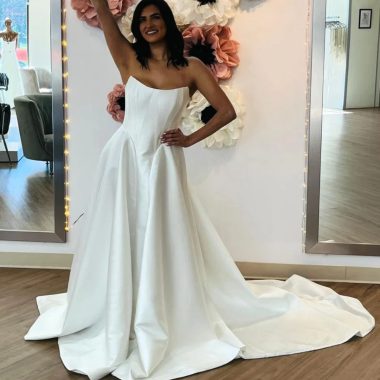
| Dahlia | Italian mikado ball gown. Scooped neckline, vertical corsetry into a basque waist, lace-up or zip back, matte or shiny finish |
| Dahlia Chantilly Lace | The same silhouette worked in Chantilly lace, with an optional sparkling underlayer |
| Gardenia | Crisp taffeta ball gown. Strapless sweetheart with pleated draping and a plunging V-notch, a bubble peplum falling into a gathered skirt |
| Cassia | Floral lace corset bodice into a basque waist, with a billowing tulle skirt and a bordered sweeping train |
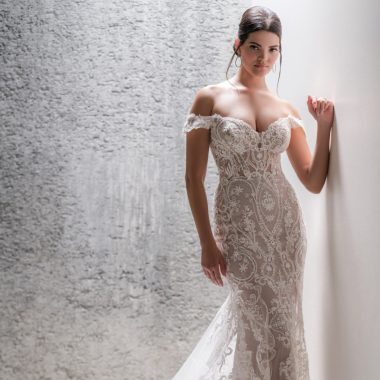
| Serraria | Form-fitting floral lace. High-neck halter, low open back, scalloped cathedral train |
| Nerine | Chantilly lace with eyelash-lace trim. Structured corset bodice, semi-sheer A-line skirt |
| Iberis | Chantilly lace. Elongated sweetheart neckline, basque waist, sweeping A-line skirt |
| Peony | Three-dimensional floral lace ball gown, with detachable gloves |
| Clivia | Sweetheart bodice, beaded floral tulle, ball gown |
| Cattleya | Sweetheart bodice, beaded floral lace. Clivia’s close relative |
| Jasmine | Square neckline, beaded lace, ball gown |
| Armeria | Corset bodice with a tiered frill skirt. The most architectural gown in the group |
| Nolina | Sheer lace bodice, soft A-line. For the bride who does not want volume |
| Kerria | Off-shoulder, floral appliqué, A-line |
| Agave | Structured bodice with a flowing skirt |
| Emberglow | A-line with a slit |
Five of those are new to our floor: Gardenia, Cassia, Serraria, Nerine and Iberis.
Two of them are the same gown in different fabrics, which catches most brides out. Dahlia exists in Italian mikado and in Chantilly lace, and they photograph so differently that people save both without realising they are looking at one design. Worth trying back to back, and we have set out the two Dahlia versions, compared.
Browse all of them on the Alena Leena wedding dresses page.
Silhouettes, ball gown through soft A-line
The sixteen split cleanly.
Ball gowns. Dahlia in both fabrics, Gardenia, Cassia, Peony, Clivia, Cattleya, Jasmine. Full skirt, defined or dropped waist, maximum presence. These suit a formal venue with room to move and a ceremony where you want to be seen from the back of the room. They are also the gowns where the petticoat decision matters most.
A-lines. Nerine, Iberis, Nolina, Kerria, Emberglow. Narrower through the hip, falling away gradually. Easier to sit down in, easier at a long reception, and more forgiving of a venue with tight aisles or a lawn.
The ones that sit between. Armeria’s corset bodice with its tiered frill skirt is its own thing, and Agave’s structured bodice over a flowing skirt reads as a soft ball gown or a strong A-line depending on how it is worn. Serraria is the single fitted gown, flaring only at the cathedral train.
If you are still working out which shape you want, our guide to wedding dress silhouettes covers how each one behaves on the body and in a Northern California venue. You can also browse by shape: ball gowns and A-line.
Fabrics and detail work
Five materials do almost all the work in this collection.
Italian mikado: A tightly woven blend with real body and a soft sheen rather than a shine. It holds a shape instead of draping into one, which is why Dahlia’s pleats stand away from the leg. Available matte or shiny, and the choice changes the gown completely. We have written separately on how mikado behaves on different body types.
Taffeta: Gardenia, and nothing else here. Crisper than mikado, it holds a sharper fold and it has a sound to it when you move. The most structural fabric on the floor.
Chantilly lace: The fine, light lace with outlined floral motifs on a delicate ground, originally from Chantilly in northern France. It reads as texture rather than decoration, and it softens every edge a structured fabric makes sharp. Three gowns use it: the lace Dahlia, Nerine and Iberis.
Beaded tulle: Clivia and Cattleya. Layers of tulle with beaded florals placed by hand, so the pattern follows the body.
Three-dimensional floral appliqué: Peony and Kerria, with floral lace also carrying Cassia and Serraria. Fabric flowers built up off the surface, which catches light from the side and casts small shadows. They are the most photogenic and the most delicate.
A fabric decision is also a season and venue decision, and that is the part brides tend to work out too late. Mikado reflects light in broad planes, so shiny mikado is beautiful under chandeliers and can be a hot-spot in full sun. Lace and tulle scatters light instead, so they wash out slightly in midday glare and become the most interesting thing in the room lit by candlelight.
For the wider picture, our guide to wedding dress fabrics covers how each material wears across a full day. You can also browse lace and beaded gowns across all our designers.
Expert insight. Made to measure is the part brides most often misunderstand. It does not mean the gown arrives needing no work. It means the gown is cut to your measurements rather than to a sample size, so there is far less to take in, and the structure sits where it was designed to sit. You will still have fittings. You will usually have fewer of them, and the result is closer to what you saw in the showroom.
Flares Bridal + Formal, Walnut Creek, California
Try the Alena Leena Collection
All sixteen gowns on one floor in Walnut Creek. Name the ones you want and we will have them ready.
What an Alena Leena gown costs
Straight answer first. Designer gowns at Flares range in price from $1,600 to $4,500, and Alena Leena sits in the upper part of our range. We do not publish a price on each gown because the customisation options change the figure, so the number you get is quoted in your appointment against the gown and the choices you make.
What we can tell you is useful anyway.
Several Alena Leena gowns are in our current sale section, and those are the cheapest way into this designer by a wide margin. Sale stock moves, so the sale page is the only honest place to see what is available and at what price today. If budget is the deciding factor, start there and tell us when you book.
Full-price gowns are a different conversation, and worth having honestly. Alena Leena is a made-to-measure house working in Italian fabrics with hand-applied detail, and that is reflected in the price. If the figure you have in mind is firm, say it when you book. Every gown we pull will have a price tag inside it, which saves you falling for something out of reach.
Payment runs 50% to 70% on ordering with the balance due when the gown arrives, and we offer interest free payment plans. Deposits on made-to-order gowns are non-refundable, which is worth knowing before you sign anything.
For the full picture on what a wedding dress costs once alterations, veil and tax are in, see our wedding dress cost guide.
Alterations on a beaded or lace gown
This is the cost nobody publishes and the one that surprises people.
Across our brides, alterations run approximately from $50 to $900 depending on how much work the gown needs, and a full couture restructure can reach $1,500. Where a gown sits in that range depends almost entirely on its surface.
- Mikado, taffeta and plain woven fabrics are the cheapest to alter well. The seams are accessible, the fabric is stable, and taking in a bodice is clean work.
- Chantilly lace costs more. Lace has to be unpicked, lifted, reset and matched across the seam so the pattern still runs. On a full lace skirt that is hours of hand work.
- Beaded tulle and three-dimensional florals cost the most. Beads and appliqué have to come off before a seam is touched and go back on afterwards, placed to match. Clivia, Cattleya, Peony, Kerria, Cassia and Serraria all fall here.
Made to measure helps, because there is less to alter in the first place. It does not eliminate the work. If two gowns feel equally right and your budget is tight, the plainer fabric is the cheaper gown to own, not just to buy.
Our alterations are done in house at the Walnut Creek store, which matters on a beaded gown because the person doing the hand work is in the same building as the gown. For the detail, see wedding dress alterations costs in the Bay Area.
How Alena Leena compares with the other designers on our floor
We carry more than a dozen designers, and the useful question is not which is best but which is best for you.
Alena Leena is for the bride who wants romance with real structure underneath, is drawn to texture and hand detail, and likes the idea of a gown made to her measurements. It is the designer to try if lace and florals appeal but a fitted lace gown does not.
Made With Love sits closest in feel: romantic, modern, popular with brides who have been saving the same kind of image. Different construction philosophy and a different price position. Worth trying alongside.
Justin Alexander and Allure are cleaner, more classic, less texture-driven, and generally more straightforward to alter. If you want a strong silhouette with minimal surface detail, start there instead. We have compared those two directly in Justin Alexander vs Allure.
Eva Lendel is the other direction: sleeker, more fashion-led, lighter on ornament.
The honest advice is to book one appointment and try three designers rather than three appointments trying one each. You learn more from the contrast than from the individual gowns, and it is the fastest way to find out what you actually respond to.
Common mistakes with this designer. Three mistakes we see repeatedly. Assuming made to order means no alterations, so no budget is set aside for them. Falling for a gown seen on another shop’s website, because collections vary by stockist and it may not be one we can get. And deciding between the two Dahlias from saved photographs, when the fabrics feel so different in the room that the decision usually makes itself in a minute.
Trying Alena Leena in Walnut Creek
All sixteen gowns are on the floor at 1700 N Broadway #100, Walnut Creek, and you can try as many as you like in one appointment.
A few things that make the appointment better.
Tell us what you want to try when you book: If Alena Leena is the reason you are coming, say so and we will have the gowns pulled and ready rather than spending your time finding them. If there is a specific gown, name it.
Bring one person whose opinion you want: Not five.
Set the budget out loud: It is the single thing that most improves an appointment, and nobody enjoys saying it. Say it anyway.
On timing: Made-to-order gowns take months to produce and then need alteration fittings on top, so nine to twelve months before the wedding is the comfortable window. Shorter is sometimes workable, especially from the sale rack, and we will tell you honestly what is still possible rather than taking an order we cannot deliver.
You can see the full collection on the Alena Leena wedding dresses page, and book from there.
Frequently asked questions
Who designs Alena Leena wedding dresses?
The brand was founded by its head designer, Alyona Kostyk. The creative studio is in Cape Town, South Africa, and the gowns are produced by the brand’s team in Ukraine.
Where are Alena Leena wedding dresses made?
By the brand’s production team in Ukraine, from Italian satin and silk, to the measurements of the bride who ordered them. The design work happens at the Cape Town studio.
Are Alena Leena wedding dresses made to measure?
Yes. Each gown is cut to your measurements rather than ordered in a standard sample size and taken in. You still have fittings, usually fewer of them, and the structure sits where it was designed to sit.
How many Alena Leena gowns does Flares Bridal stock?
Sixteen, on the floor in Walnut Creek, including five added in November 2026: Gardenia, Cassia, Serraria, Nerine and Iberis. Collections vary by stockist, so a gown on another shop’s site may not be one we carry. The sixteen are listed above.
How much is an Alena Leena wedding dress at Flares Bridal?
Each gown is quoted in the appointment, because the customisation choices change the figure. Several Alena Leena gowns are in our current sale, which is the cheapest route into the designer.
Do Alena Leena gowns come in plus sizes?
The gowns are made to your measurements, which is a meaningful advantage over ordering a standard size and altering it. Tell us your measurements when you book and we will be straight with you about what we can do.
Is the Alena Leena Dahlia mikado or lace?
Both. Dahlia was designed in Italian mikado and is also produced in Chantilly lace over the same silhouette. We stock both, which is why we recommend trying them back to back rather than choosing from photographs.
Does Alena Leena make a fitted wedding dress?
Serraria, and only Serraria. It is form-fitting floral lace with a high-neck halter, a low open back and a scalloped cathedral train. The other fifteen gowns are ball gowns and A-lines.
How long does an Alena Leena gown take to arrive?
Allow several months for production and then time for fittings on top. Nine to twelve months before the wedding is comfortable. If your date is sooner, say so when you book and we will tell you what is realistic.
How do I care for an Alena Leena gown before the wedding?
Keep it in a breathable garment bag rather than plastic, hang it by the loops inside the bodice rather than the shoulders, and handle beaded and appliquéd areas as little as possible. After the wedding, have it professionally cleaned by someone who works on beaded gowns.
Book Your Alena Leena Appointment
Sixteen gowns, made to your measurements, with alterations done in house.