What this guide covers
- Two gowns, one name
- Dahlia mikado vs Dahlia Chantilly lace, side by side
- The mikado Dahlia: structure and a quiet sheen
- The Chantilly lace Dahlia: texture, and the sparkle question
- Which Dahlia is for which bride
- How each one behaves in your venue’s light
- What you can change on either one
- What a Dahlia costs, and what alterations add
- Trying both Dahlias on in Walnut Creek
- Frequently asked questions
Two gowns, one name
If you have been saving Alena Leena Dahlia photos, you have probably noticed something odd. Some of them show a smooth, sculpted ball gown with a quiet sheen. Others show the same shape covered in fine floral lace. They look like two different dresses because they are.
Dahlia exists in two fabrics. The original is cut from Italian mikado. The second takes the identical silhouette and works it in Chantilly lace. Same gown, same architecture, two completely different moods.
Most boutiques carry one or the other, which is why nothing online explains the difference. Alena Leena’s own Dahlia page covers only the mikado. We stock both at our Walnut Creek store, so this is the comparison we end up making out loud several times a month.
Dahlia mikado vs Dahlia Chantilly lace, side by side
| Dahlia, Italian mikado | Dahlia, Chantilly lace | |
|---|---|---|
| Fabric | Italian mikado, available matte or shiny | Chantilly lace over the same base shape |
| Silhouette | Ball gown, pleated full skirt with flared sides | Ball gown, full and voluminous |
| Neckline | Scooped, with subtle peaks at the edges | Scooped |
| Bodice | Vertical corsetry running into a basque waist | Lace-covered, same corseted structure underneath |
| Closure | Lace-up or zip | Lace-up or zip |
| Volume control | Structured petticoat optional | Structured petticoat optional |
| Sparkle option | Matte or shiny mikado | Sparkling underlayer, or sequin free |
| Reads as | Modern, architectural, clean | Romantic, textured, vintage leaning |
| Alterations | More straightforward, seams are accessible | More hand work, lace has to be lifted and reset |
The mikado Dahlia: structure and a quiet sheen
Mikado is a tightly woven blend with real body to it. It holds a shape rather than draping into one, and it carries a soft sheen instead of a shine. On Dahlia that body is doing the work: the skirt is pleated into deep folds that stand away from the leg, and the sides flare rather than falling straight.
The bodice is where this version earns its reputation. Vertical corsetry runs down the front and carries into a basque waist, which is the dropped V that sits below the natural waist. On a scooped neckline that combination does something specific. The eye travels down the vertical lines and the waist point lengthens everything above the skirt. Alena Leena describes the effect as simply elegant, and that is about right. There is no beading, no appliqué, nothing competing with the line.
You choose matte or shiny mikado. Matte reads more modern and photographs flatter, which suits a gallery or a loft. Shiny picks up light along every pleat, which is what you want under chandeliers.
If mikado is new to you, we have written separately about how mikado behaves on different body types, and the fabric sits inside the wider guide to wedding dress fabrics.
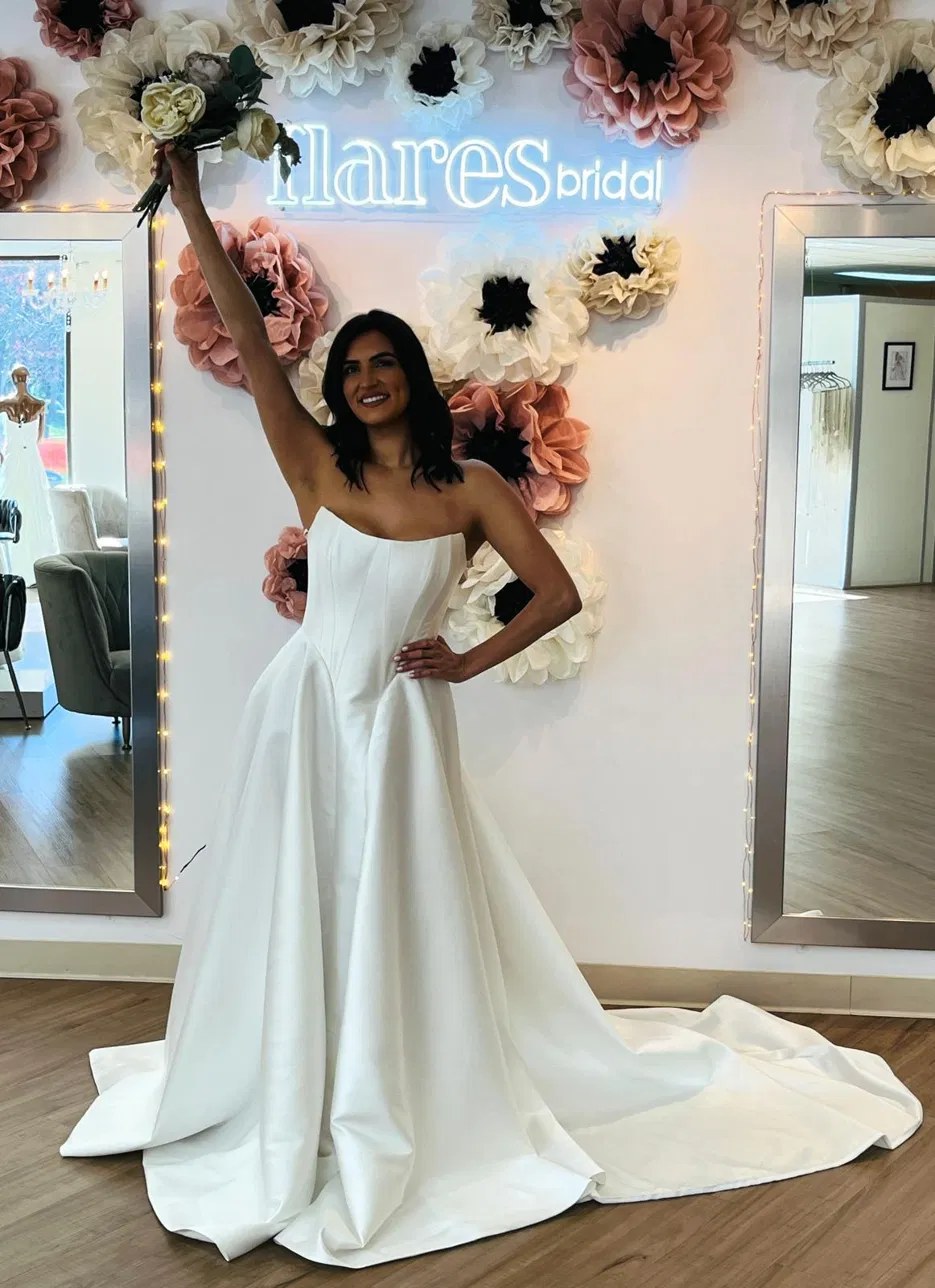
The Dahlia in Italian mikado. The fabric holds the pleats away from the leg rather than letting them fall flat.
The Chantilly lace Dahlia: texture, and the sparkle question
Chantilly lace is the fine, light lace with outlined floral motifs on a delicate ground, originally from Chantilly in northern France. It is the opposite of a heavy guipure. It sits close, it moves, and it reads as texture rather than as decoration.
Laid over the Dahlia silhouette, it softens every edge the mikado version makes sharp. The pleats are still there, but you read them as shadow instead of structure. The corsetry is still underneath, so you keep the waist and the support, and lose the architectural look.
Then there is the decision most brides do not know they have. The lace Dahlia comes with an optional sparkling underlayer. With it, the lace catches candlelight and the whole gown shifts between still and shimmering as you move. Without it, the lace pattern stays the only thing your eye does, and the gown is markedly quieter.
So Dahlia is really three looks, not two: mikado, lace with sparkle, lace without. Nobody tells you that online, because no other shop has all three on the floor to show you.
Did you know? Every Alena Leena gown is named after a flower. It is not a styling choice, it is the brand’s design method: each dress starts from the symbolism of its flower. Dahlia belongs to the Petal Crush collection, and the gown’s deep folded pleats read as petals once you know to look for them.
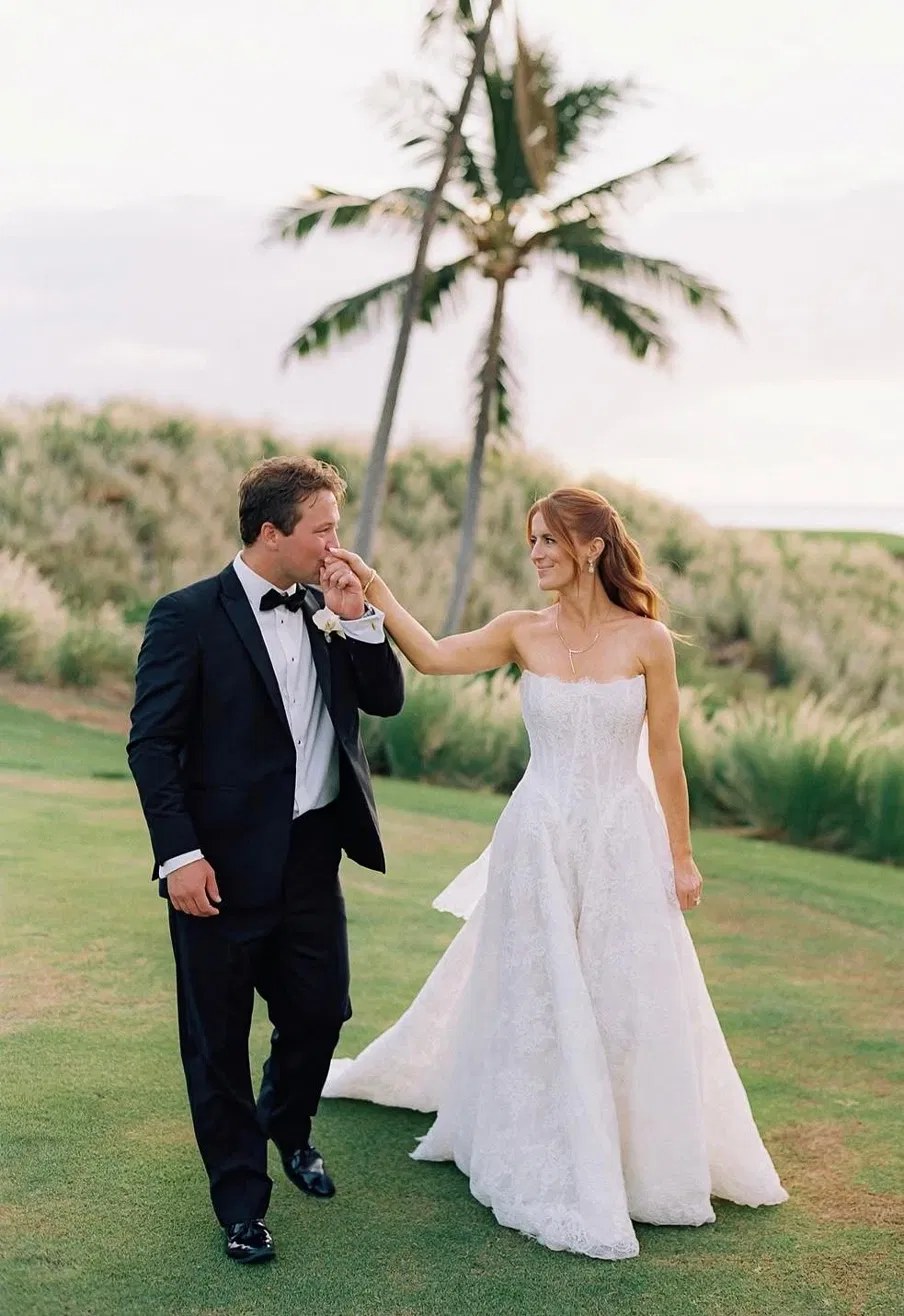
A Flares Bridal bride in the Chantilly lace Dahlia. The same silhouette, reading completely differently.
Which Dahlia is for which bride
After enough appointments, the split is fairly predictable.
The mikado Dahlia tends to win when:
- She likes clean lines and is nervous about looking fussy
- The venue is modern: a gallery, a winery barrel room, a city rooftop, a loft
- She wants the gown to read as one strong shape in photographs
- She is taller, or wants to look it, and the vertical corsetry is doing that for her
- She is working to a tighter alterations budget
The Chantilly lace Dahlia tends to win when:
- She wanted lace from the start but did not want a fitted lace gown
- The setting is a garden, an estate, a candlelit dinner, a church
- She is drawn to vintage texture without wanting a vintage silhouette
- She wants softness near the face, which the lace gives at the neckline
- She likes the idea of choosing her own level of sparkle
The honest version: brides who try both almost always know within a minute. The fabrics feel so different to wear that the decision stops being analytical. Which is the argument for trying both rather than deciding from photographs.
Expert insight. The mistake we see is brides deciding between these two from saved photos, then arriving convinced. Photographs flatten fabric. Mikado looks softer on a screen than it feels in the room, and Chantilly lace looks busier than it reads in person. We keep both Dahlias on the floor precisely so that comparison happens with the gowns on, not on a phone.
Flares Bridal + Formal, Walnut Creek, California
How each one behaves in your venue’s light
This is the part that rarely comes up and matters more than it should.
Mikado reflects light in broad planes. In bright daylight, matte mikado photographs as a clean ivory block and shiny mikado can hot-spot along the pleats. Under warm indoor light, shiny mikado is beautiful: every fold picks up a highlight.
Chantilly lace scatters light instead of reflecting it. In full sun the pattern can wash out slightly and read as plain cream from a distance. In candlelight or warm evening light it does the opposite and becomes the most interesting thing in the room, especially with the sparkling underlayer.
Rough rule. Daytime outdoors, matte mikado or sequin-free lace. Evening indoors, shiny mikado or a sparkling lace. A long reception that starts in daylight and ends in candlelight is where the lace with sparkle earns its place, because it changes character across the day and the mikado does not.
For a broader look at matching gowns to Northern California settings, our guide to wedding dress silhouettes covers how a ball gown behaves in each venue type.
What you can change on either one
Alena Leena gowns are made to your measurements, not bought off a rack and taken in, which means several decisions are yours at the point of order rather than at alterations.
On both Dahlias:
1. Closure: Lace-up back or a zip. The lace-up gives a little adjustability through fittings and reads more traditional.
2. Volume: Worn with a structured petticoat for full ball gown presence, or without for a softer, more relaxed skirt.
3. Hem length: Ordered to your height, which matters on a full skirt where a bad hem is immediately visible.
Specific to each:
- Mikado: matte or shiny finish
- Lace: sparkling underlayer, or sequin free
Pro tip. Decide the petticoat question at the appointment, not later. It changes the hem length you order, and a skirt hemmed for a petticoat you then decide against will sit long. Walk in both configurations before you choose.
Try Both Dahlias in Walnut Creek
Tell us you want to compare the mikado and the lace and we will have both pulled before you arrive.
What a Dahlia costs, and what alterations add
Designer gowns at Flares start at $1,600, and Alena Leena sits in the upper part of our range. The exact figure depends on the version and the customisations you choose, so both Dahlias are quoted in your appointment rather than listed online. Several Alena Leena gowns are in our current sale, and that is the cheapest way into this designer, so it is worth asking what is on the sale rail when you book.
Alterations are the part brides underestimate. Across our brides, alterations run $50 to $900 depending on how much work the gown needs, and a full couture restructure can reach $1,500. Between the two Dahlias there is a real difference:
- Mikado is more straightforward. The seams are accessible, the fabric is stable, and taking in a bodice is clean work.
- Chantilly lace costs more to alter well. Lace has to be unpicked, lifted, reset and matched across a seam so the pattern still runs. On a lace ball gown that is hand work, and hand work is hours.
Budget accordingly. If the two gowns feel equally right and the budget is tight, the mikado is the cheaper gown to own, not just to buy.
Payment runs 50% to 70% on ordering with the balance due when the gown arrives, and we offer interest free payment plans. Deposits on made-to-order gowns are non-refundable, which is worth knowing before you sign.
For the full picture on what a gown costs once alterations, veil and tax are in, see our wedding dress cost guide and the detail on alterations costs in the Bay Area.
Common mistakes with Dahlia. Three we see repeatedly. Assuming the lace version is just the mikado with lace on top, when the whole character changes. Forgetting that a made-to-order gown takes months, so deciding late costs you the option entirely. And ordering the sparkling underlayer because it looks good in the showroom, without checking how it behaves in the light your wedding actually happens in.
Trying both Dahlias on in Walnut Creek
Both versions are on the floor at 1700 N Broadway #100 in Walnut Creek. You can try them back to back in one appointment, which is not something you can do at most shops carrying this designer.
A few practical notes. Bring the shoes you expect to wear, or something close in height, because hem decisions on a ball gown depend on it. Bring one person whose opinion you actually want. And tell us when you book that you want to compare both Dahlias, so we have both pulled and ready rather than spending your appointment finding them.
Made-to-order gowns take several months to arrive and then need fittings on top, so the comfortable window is nine to twelve months out. If your date is sooner than that, say so when you book and we will tell you honestly what is still possible.
You can see both gowns on the Alena Leena wedding dresses page, or go straight to the mikado Dahlia and the Chantilly lace Dahlia. For the designer’s story and the rest of the collection we stock, start with our Alena Leena designer guide.
Frequently asked questions
Is the Alena Leena Dahlia mikado or lace?
Both. Dahlia was designed in Italian mikado, and Alena Leena also produces it in Chantilly lace over the same silhouette. The designer’s own Dahlia page shows only the mikado, which is why the two get confused online. Flares Bridal stocks both.
What is the difference between the two Dahlia versions?
The shape, bodice and closure are the same. The fabric changes everything else. Mikado is structured with a soft sheen and reads modern and architectural. Chantilly lace is textured and soft and reads romantic and vintage leaning. The lace version also offers an optional sparkling underlayer, so there are three looks in total.
Does the Dahlia have a basque waist?
Yes. Vertical corsetry on the bodice runs into a dropped V waist below the natural waistline, which lengthens the body above the skirt. The structure is the same under the lace version, where it is covered rather than visible.
Can I wear the Dahlia without a petticoat?
Yes. Both versions are designed to work with or without a structured petticoat. With one you get full ball gown volume. Without, the skirt falls softer. Decide at your appointment, because it affects the hem length you order.
How much does an Alena Leena Dahlia cost at Flares Bridal?
Designer gowns at Flares start at $1,600 and Alena Leena sits in the upper part of our range. The final figure depends on the version and the customisations you choose, so both Dahlias are quoted in the appointment. Alterations are separate and run approximately from $50 to $900 for most brides.
Is the lace Dahlia more expensive to alter than the mikado?
Usually, yes. Altering lace means unpicking, lifting and resetting it so the pattern still matches across the seam, and on a full lace ball gown that is hours of hand work. Mikado seams are more accessible and the fabric is more stable, so the same alteration is cleaner work.
How long does it take to order a Dahlia?
Alena Leena gowns are made to your measurements, so allow several months for production and then time for fittings on top. Nine to twelve months before the wedding is the comfortable window. Shorter timelines are sometimes workable, and we will tell you honestly when you book.
Can I try both Dahlias on in the same appointment?
Yes, and we recommend it. Both are on the floor in Walnut Creek. Mention it when you book so both are pulled before you arrive, rather than using your appointment time to find them.
Book Your Bridal Appointment
Both Dahlias on the floor at 1700 N Broadway #100, Walnut Creek, with in-house alterations.